Recommended Carrier
Carrier Name
Service TypeReasoning goes here.
Reasoning goes here.
Enter your product details to see the optimal shipping strategy.
Choosing the wrong shipping partner can quietly drain your profit margins until you’re left wondering where the money went. You might think all carriers are just boxes on trucks, but in ecommerce, they are distinct ecosystems with different strengths, weaknesses, and pricing models. There is no single "best" company for everyone because your ideal choice depends entirely on what you sell, where your customers live, and how fast you need to move inventory.
In 2026, the landscape has shifted significantly. The rise of regional carriers, the consolidation of global networks, and new technologies like real-time tracking APIs have changed the game. If you are selling heavy items, a standard postal service will likely fail you. If you are selling low-cost digital goods or small accessories, paying for premium expedited shipping makes no sense. This guide breaks down the major players, their specific use cases, and how to build a strategy that actually works.
When most people ask about shipping companies, they think of UPS, United Parcel Service, FedEx, and USPS, United States Postal Service. These three dominate the market for good reason: coverage. They go everywhere. But "everywhere" comes at a price.
USPS remains the king of residential deliveries for small packages. Their network is vast, reaching rural areas where private carriers often charge hefty surcharges. For ecommerce sellers shipping items under 10 pounds, especially those using Priority Mail, USPS offers competitive rates and reliable two-to-three-day delivery without the complexity of zone-based pricing. However, their tracking systems have historically been less granular than competitors, though this has improved with recent API updates.
UPS excels in reliability and heavy freight. If you are shipping furniture, electronics, or anything over 20 pounds, UPS’s ground network is robust. Their technology integration is top-tier, allowing for precise delivery windows and easy return label generation. The downside? They can be expensive for small, lightweight parcels unless you negotiate heavily based on volume.
FedEx sits somewhere in between. They are incredibly strong in business-to-business (B2B) shipping and time-sensitive deliveries. If your customers expect next-day arrival, FedEx Express is often the safer bet than UPS Ground. However, for standard residential ecommerce shipments, FedEx Ground can sometimes be more costly than UPS or USPS depending on the origin and destination zones.
If you want to save money and improve delivery speed in specific regions, you need to look beyond the big three. Regional carriers have exploded in popularity because they offer better customer service and lower costs for local deliveries.
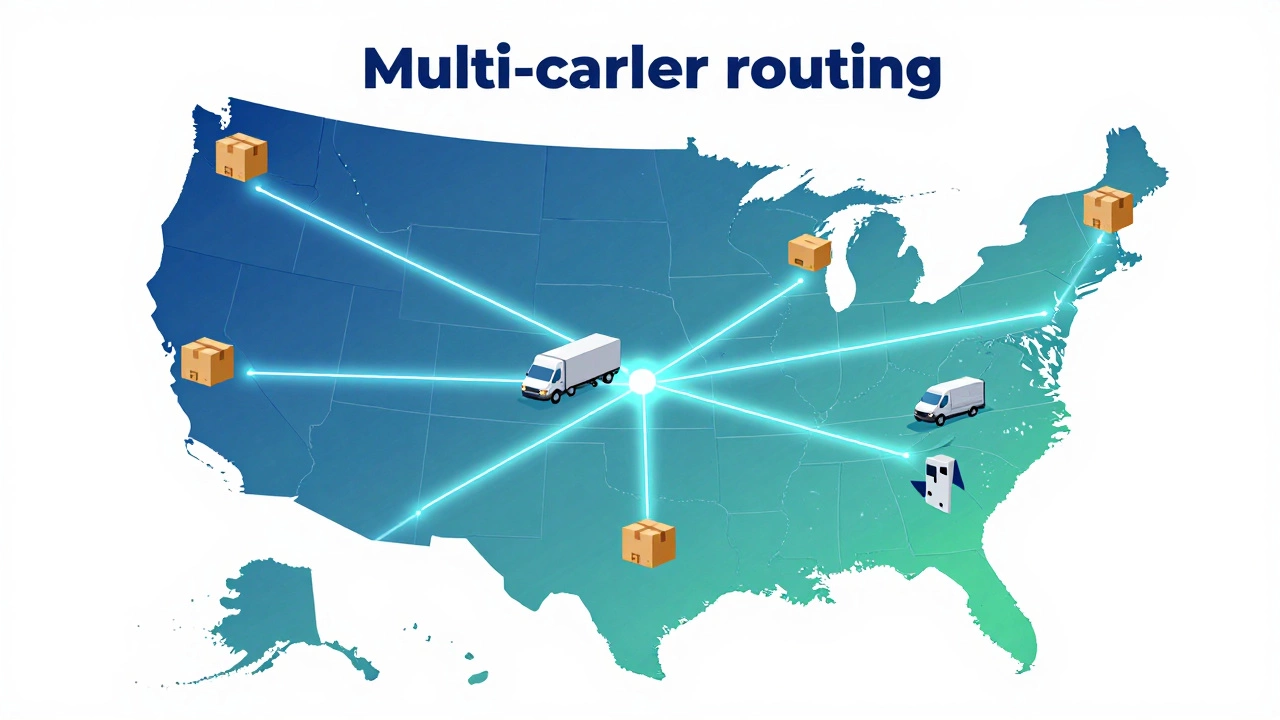
The catch with regional carriers is coverage. They do not go nationwide. To leverage them effectively, you need a shipping software platform that can automatically route orders to the best carrier based on the customer’s zip code. This is known as multi-carrier routing.
Before signing any contract, audit your product catalog. What is the average weight of your order? What are the dimensions? How fragile are the items?
If you sell small, lightweight items (under 4 lbs), USPS First Class Package is unbeatable. It’s cheap, simple, and widely accepted by consumers who expect free shipping. Many successful dropshippers and Etsy sellers rely almost exclusively on this service.
If you sell medium-weight items (5-20 lbs), you enter the "ground shipping" battleground. Here, UPS Ground and FedEx Ground compete fiercely. Compare rates using a tool like Pirate Ship or Shippo. Often, the difference is pennies, so choose the one with better tracking visibility for your team.
If you sell heavy or bulky items (over 70 lbs), consider freight shipping. Companies like XPO Logistics or Estes Express specialize in LTL freight. Standard parcel carriers will charge you dimensional weight pricing that destroys your margin on large items. Freight shipping requires palletizing, which adds labor costs, but it protects your bottom line on high-value goods.
The base rate is only part of the story. In 2026, carriers are increasingly aggressive with surcharges. You must account for these hidden fees in your pricing model.
| Surcharge Type | Description | Who Charges It? |
|---|---|---|
| Fuel Surcharge | A percentage added to cover fluctuating fuel prices. Changes weekly. | All Major Carriers |
| Residential Delivery | Extra fee for delivering to homes instead of businesses. | UPS, FedEx |
| Remote Area | Fee for delivering to hard-to-reach rural locations. | UPS, FedEx, USPS |
| Oversized/Overweight | Penalty for packages exceeding standard size/weight limits. | All Carriers |
To mitigate these costs, use a shipping aggregator. Platforms like Shippo, EasyPost, or Pirate Ship allow you to buy labels at commercial plus discounts, which are significantly cheaper than retail counter rates. They also help you avoid dimensional weight errors by calculating volumetric weight accurately before you print the label.
If your ecommerce store ships globally, the rules change completely. Domestic carriers become expensive quickly once they cross borders.
USPS Priority Mail International is often the most cost-effective way to get packages out of the country for small businesses. It includes some insurance and tracking, though tracking may stop once the package enters the destination country’s postal system. For higher-value items, DHL Express is the gold standard for international speed and customs clearance. DHL handles customs paperwork more efficiently than most other carriers, reducing the risk of packages getting stuck in limbo.
Always ensure your ecommerce platform automatically calculates duties and taxes at checkout. Services like Global-e or Borderlex can help automate this process, preventing surprise fees that lead to returned packages and unhappy customers.

The smartest ecommerce businesses do not rely on a single carrier. They use a hybrid approach:
This strategy requires investment in shipping software that supports multiple carriers. The ROI comes from reduced shipping costs, faster delivery times, and fewer lost packages. Remember, shipping is not just a logistics problem; it is a customer experience problem. Fast, transparent, and affordable shipping builds trust and encourages repeat purchases.
There is no magic bullet. The "best" shipping company is the one that aligns with your specific product mix, customer demographics, and budget constraints. Start with USPS for simplicity if you are small. As you grow, negotiate contracts with UPS and FedEx. Incorporate regional carriers to optimize costs. And always, always use shipping software to compare rates in real-time. Your shipping strategy should evolve as your business does.
Yes, for packages under 10 pounds, USPS First Class Package Service is typically much cheaper than UPS Ground. USPS does not charge residential delivery surcharges or remote area fees in the same way UPS does, making it the preferred choice for lightweight ecommerce items.
For items over 70 pounds, Less Than Truckload (LTL) freight shipping is usually more cost-effective than parcel shipping. Carriers like XPO Logistics or Estes Express specialize in this. Standard carriers like UPS will charge excessive dimensional weight fees for heavy, bulky items.
Use a shipping aggregator like Pirate Ship or Shippo to access commercial discounts. Optimize your packaging to reduce dimensional weight. Implement a multi-carrier strategy to route packages via the cheapest available option based on destination. Finally, negotiate annual contracts with carriers once you reach a certain volume.
Yes, regional carriers like LaserShip and OnTrac are highly reliable within their service areas. They often provide faster delivery and better customer service than national giants for local routes. The limitation is that they do not serve the entire country, so you need software to manage routing.
For cost-effectiveness, USPS Priority Mail International is great for small, low-value items. For speed, reliability, and superior customs handling, DHL Express is the industry leader for international shipments. FedEx International Economy is also a strong competitor for mid-range international needs.