What Software Does FedEx Freight Use? A Deep Dive Into Their Tech Stack

FedEx Freight Integration Pathway Calculator
Step 1: Define Your Business Profile
🛒 E-commerce Platform
Shopify, Magento, WooCommerce🏢 ERP System
SAP, Oracle, Microsoft Dynamics💻 Custom Software
In-house built applicationStep 2: Technical Requirements
Select all features you need from the integration:
Your Recommended Integration Pathway
Primary Method
Implementation Timeline
EDI vs API Comparison for Your Use Case
| Feature | EDI | API |
|---|
Have you ever wondered what happens behind the scenes when a massive pallet of goods leaves a warehouse and heads across the country? For FedEx Freight, the less-than-truckload (LTL) shipping division of FedEx Corporation, it’s not just about trucks and drivers. It is about a complex, invisible web of software that tracks every inch of movement, calculates costs in real-time, and predicts delays before they happen. While FedEx does not publish a public list of every single line of code running its network, industry analysis, job postings, and vendor partnerships reveal a sophisticated tech stack built on custom proprietary systems integrated with major enterprise platforms.
If you are a shipper trying to integrate your business with them, or a logistics professional curious about industry standards, understanding this technology is key. You aren't just buying a shipping label; you are plugging into one of the most advanced data networks in the world. Let's break down exactly what powers this machine.
The Core: Proprietary Logistics Platforms
At the heart of any major carrier is a custom-built engine. FedEx Freight does not rely solely off-the-shelf software for its core operations because no commercial product can handle their specific volume and complexity. They have developed internal systems over decades to manage Less-Than-Truckload (LTL) shipping where multiple customers' shipments share space in the same truck.
This proprietary stack handles three critical functions:
- Rate Management: Calculating dynamic pricing based on weight, density, distance, fuel surcharges, and accessorial services instantly.
- Network Optimization: Determining which terminals handle which stops to minimize empty miles and maximize load factors.
- Dispatching: Assigning loads to specific drivers and trucks based on location, availability, and regulatory hours-of-service rules.
These systems are tightly coupled with physical assets. When a driver scans a package at a terminal, that data flows immediately into the central database, updating the status for everyone from the warehouse manager to the end customer. This level of integration requires robust backend infrastructure, likely hosted on hybrid cloud environments to ensure low latency and high security.
Integration with Major Enterprise Systems
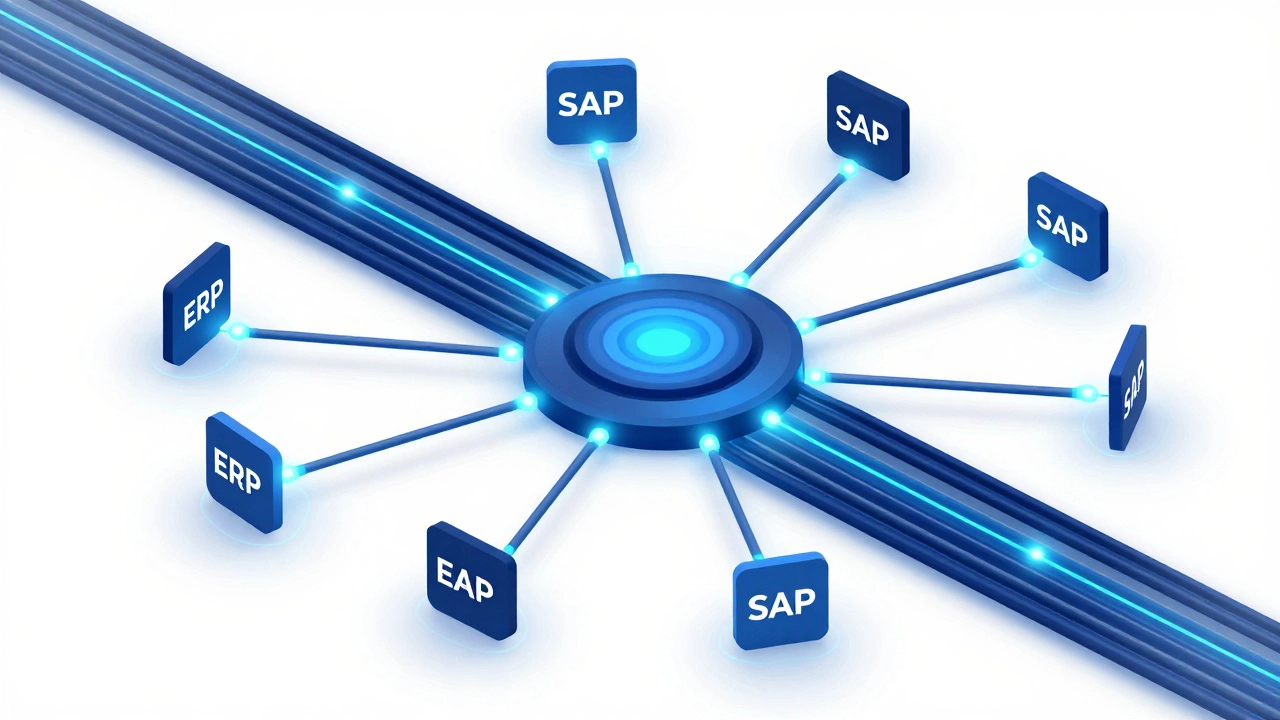
While the core logic is custom, FedEx Freight integrates with well-known enterprise resource planning (ERP) and transportation management systems (TMS) to communicate with shippers. If you are using a major platform like SAP a leading global provider of enterprise software to manage business operations and customer relations, Oracle, or Microsoft Dynamics, you will find native connectors or API integrations designed specifically for FedEx Freight.
For smaller businesses or those using specialized TMS providers like Blue Yonder formerly JDA Software, a supply chain management software company, Manhattan Associates, or Project44, FedEx provides standardized APIs. These applications programming interfaces allow external software to query rates, create shipments, and track packages without needing to log into the FedEx website manually.
| Software Type | Example Providers | Integration Method |
|---|---|---|
| ERP Systems | SAP, Oracle NetSuite, Microsoft Dynamics | Native Connectors / EDI |
| TMS Platforms | Blue Yonder, Manhattan, MercuryGate | REST APIs / SOAP |
| E-commerce Platforms | Shopify Plus, Magento, WooCommerce | Plugins / Middleware |
| Visibility Tools | Project44, FourKites | API Data Feeds |
Data Exchange Standards: EDI and APIs
How does your computer talk to FedEx’s servers? Historically, the answer was Electronic Data Interchange (EDI). Even today, EDI Electronic Data Interchange, a standard format for exchanging business documents between organizations remains the backbone of large-scale freight transactions. FedEx Freight supports standard EDI transactions such as:
- EDI 204: Motor Carrier Load Tender (sending a load offer).
- EDI 210: Rate Request Reply (getting a price quote).
- EDI 214: Shipment Status Message (tracking updates).
- EDI 856: Advance Ship Notice (confirming what is on the truck).
However, the industry is shifting toward Application Programming Interfaces (APIs). APIs are faster, more flexible, and easier to implement than traditional EDI. FedEx has invested heavily in its FedEx Developer Portal a platform providing tools and documentation for developers to integrate FedEx services. Through this portal, developers can access RESTful APIs for rating, labeling, tracking, and address validation. This shift allows modern startups and agile companies to integrate with FedEx Freight without the heavy overhead of setting up an AS2 VAN (Value-Added Network) for EDI.
Customer-Facing Tools: MyFedEx and Tracking
You probably know the interface better than the backend. The MyFedEx FedEx's online account management and shipping platform portal is the primary touchpoint for most users. This web application is built on modern frontend frameworks, likely utilizing technologies like React or Angular for a responsive user experience. It pulls data from the backend proprietary systems to display real-time tracking maps, delivery windows, and proof of delivery images.
For mobile users, the FedEx Driver App and the Customer Mobile App use native iOS and Android development stacks. These apps leverage GPS data, cellular networks, and sometimes Bluetooth beacons in terminals to provide hyper-local tracking accuracy. When you see a map showing your truck moving between cities, that is a visualization layer sitting on top of millions of data points processed by the core logistics software.

Emerging Technologies: AI and IoT
FedEx Freight isn't resting on legacy systems. They are actively integrating artificial intelligence (AI) and the Internet of Things (IoT) to improve efficiency.
Predictive Analytics: Machine learning models analyze historical weather patterns, traffic data, and seasonal demand spikes to predict potential delays. This allows FedEx to proactively reroute shipments or notify customers before a problem occurs.
IoT Sensors: Many LTL shipments now include smart sensors that monitor temperature, humidity, shock, and tilt. This data feeds back into the system, providing quality assurance for sensitive goods like pharmaceuticals or electronics. If a sensor detects a sudden impact, an alert is generated automatically in the software system, flagging the shipment for inspection upon arrival.
Automation in Terminals: Inside FedEx Freight hubs, automated sorting systems and robotic arms work in tandem with software directives. Computer vision algorithms identify labels and direct packages to the correct chute or trailer position, reducing manual handling errors and speeding up cross-docking processes.
Why This Matters for Your Business
Understanding that FedEx Freight uses a mix of proprietary engines, standard EDI/API protocols, and modern AI tools helps you make better decisions. If you are looking to automate your shipping, don't try to build a custom parser for their website. Instead, look for a TMS that offers native FedEx Freight integration via API. This ensures you get accurate rates and real-time tracking without breaking your system during FedEx's inevitable software updates.
Furthermore, knowing that they support EDI means you can scale from manual entry to fully automated high-volume shipping as your business grows. You start with a plugin, move to an API connection, and eventually implement full EDI interchange as your transaction volume justifies the setup cost.
Does FedEx Freight use SAP?
FedEx Freight does not publicly state that SAP runs its core logistics operations, which are largely proprietary. However, they offer robust integration capabilities for shippers who use SAP ERP systems. This allows businesses using SAP to seamlessly exchange rate, tender, and tracking data with FedEx Freight through standard EDI transactions or API connectors.
Can I integrate my custom software with FedEx Freight?
Yes, you can. FedEx provides a comprehensive Developer Portal with RESTful APIs. These APIs allow custom software applications to request rates, create shipments, generate labels, and track packages programmatically. You will need to register for a developer account and obtain API credentials to begin testing and implementation.
What is the difference between EDI and API for FedEx Freight?
EDI (Electronic Data Interchange) is a traditional, batch-oriented method for exchanging standardized business documents, often requiring third-party VAN services. It is best for high-volume, repetitive transactions. APIs (Application Programming Interfaces) are real-time, web-based connections that allow for immediate data exchange. APIs are generally easier to implement, more flexible, and better suited for modern web and mobile applications.
Is FedEx Freight tracking software accurate?
FedEx Freight tracking is highly accurate due to its integration with driver handheld devices, terminal scanning systems, and GPS data. The software updates status at key milestones: pickup, departure from origin terminal, arrival at destination terminal, out for delivery, and final delivery. Real-time map tracking provides approximate locations based on the last known scan or GPS ping.
Does FedEx Freight use blockchain technology?
As of 2026, there is no widespread public evidence that FedEx Freight relies on blockchain for its core domestic LTL operations. While FedEx has experimented with blockchain for international trade documentation and provenance tracking in other divisions, the primary freight software stack remains focused on relational databases, cloud computing, and AI-driven analytics for efficiency and speed.