Is MDF or OSB Better for Shelves? The Real Difference Explained
Shelf Weight Capacity Calculator
Shelf Weight Calculator
Calculate maximum safe weight capacity for your DIY shelves based on material type, span length, and support spacing. Based on real-world testing from New Zealand builders.
Results
When you're building shelves - whether for your garage, closet, or home office - the material you pick makes all the difference. Two of the most common choices are MDF and OSB. But which one actually holds up better under real-world use? Let’s cut through the marketing noise and look at what happens when you stack books, boxes, or tools on these panels day after day.
What Is MDF?
MDF stands for Medium Density Fiberboard. It’s made by breaking down hardwood or softwood residuals into fibers, mixing them with wax and resin, then pressing them into panels under high heat and pressure. The result? A smooth, uniform surface with no grain, knots, or voids.
That smoothness is why MDF is popular for painted shelves. It takes paint like a dream - no grain to show through, no sanding nightmares. You can get a finish that looks like solid wood without the cost. In New Zealand, MDF is widely available at hardware stores like Bunnings, and it’s often the go-to for custom cabinetry.
But here’s the catch: MDF doesn’t handle moisture well. If a glass of water sits on it for too long, or if your basement gets damp, it swells. And once it swells, it doesn’t bounce back. It turns soft, crumbly, and useless. It also has zero structural strength on its own. A 24-inch MDF shelf holding 50 pounds of books? That’s asking for trouble unless you add heavy-duty supports underneath.
What Is OSB?
OSB - Oriented Strand Board - is made from thin, rectangular wood strands that are layered and bonded with waterproof resin. The strands are arranged in cross-directions, which gives OSB its strength. It looks rough, chunky, and industrial. You’ve probably seen it on construction sites as subflooring or roof sheathing.
OSB is strong. Really strong. A 3/4-inch OSB shelf can hold more weight than an equally thick MDF shelf, especially over longer spans. It’s also more resistant to moisture. Not waterproof, but it won’t swell as badly if it gets wet. That’s why OSB is often used outdoors or in garages where humidity swings are common.
But OSB has downsides. Its surface is rough. If you’re painting it, you’ll need multiple coats of primer and sanding. Even then, the texture might still show through. And if you’re putting it in a visible spot - like a living room shelf - it looks cheap. Unless you’re going for rustic industrial, it’s not ideal for aesthetics.
Weight Capacity: MDF vs OSB
Let’s get specific. A 3/4-inch MDF shelf, 36 inches long, with supports every 16 inches, can safely hold about 40-50 pounds. Push it to 60 pounds, and you’ll see sagging within weeks. That’s fine for books, small decor, or canned goods - but not for toolboxes or heavy storage bins.
Now, take the same size shelf in 3/4-inch OSB. With the same support spacing, it handles 70-80 pounds easily. Some builders have tested OSB shelves holding over 100 pounds with no visible sag - as long as the supports are solid. OSB’s layered structure spreads the load better than MDF’s dense, uniform core.
Here’s a real-world example from a Wellington homeowner: They built a garage shelf using MDF to store gardening tools. After one rainy winter, the center of the shelf sagged by over half an inch. They replaced it with OSB. Two years later? Still flat. No warping, no soft spots.
Moisture Resistance: Where Each Material Fails
MDF and OSB both fail in wet environments - but differently.
MDF turns into a wet paper towel. One spill, one leaky pipe, and it starts to swell. It doesn’t recover. You’ll need to cut it out and start over. Even high humidity over time can cause it to soften. That’s why you never see MDF in bathrooms or laundry rooms unless it’s sealed with multiple layers of moisture-resistant paint.
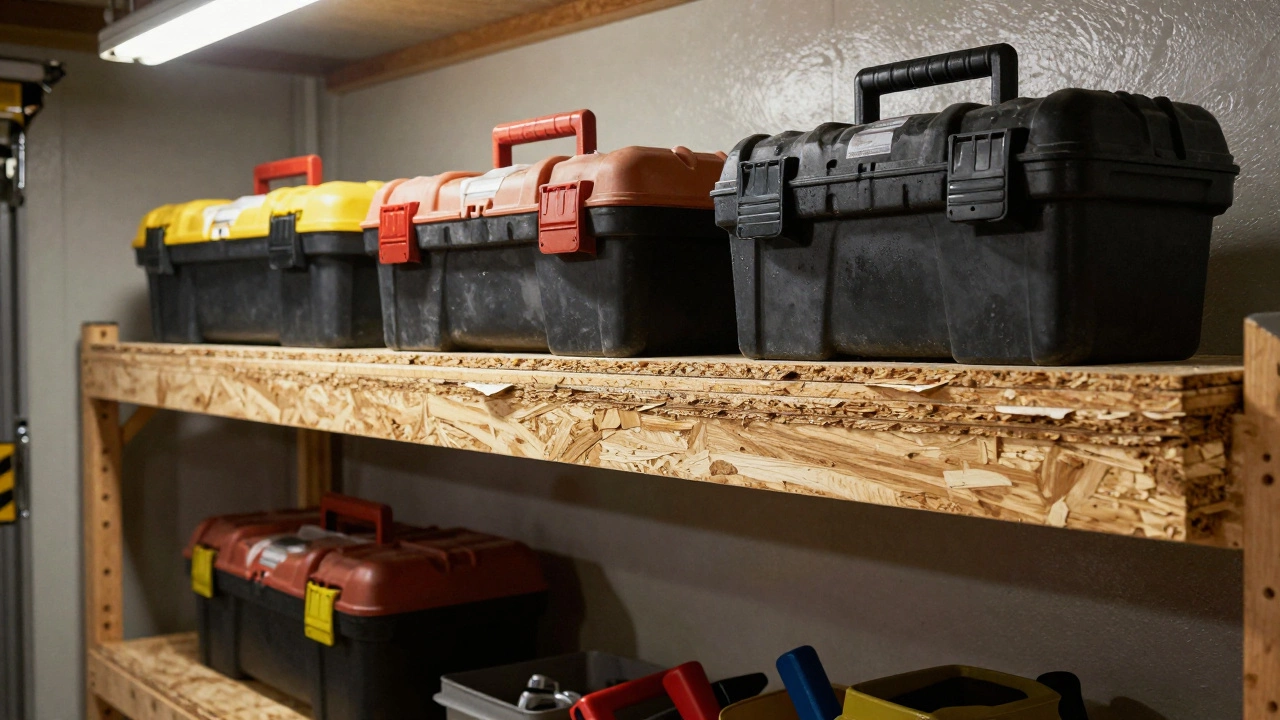
OSB, on the other hand, swells at the edges when exposed to water - especially if the edges aren’t sealed. But the core stays firm. Once it dries, it regains most of its strength. That’s why OSB is allowed in exterior sheathing. For shelves in garages, sheds, or basements, OSB is the smarter pick.
Cost and Availability
On paper, MDF is cheaper. A 4x8-foot sheet of 3/4-inch MDF costs around NZ$65. OSB runs about NZ$75. That $10 difference might seem small, but when you’re building five shelves, it adds up.
But here’s what most people miss: labor cost. MDF is easier to cut and sand. It’s lighter. It’s easier to paint. If you’re doing the work yourself, MDF saves time. OSB needs more prep - sanding, priming, sealing - which adds hours. If you’re hiring someone, that labor cost can eat up the material savings.
In New Zealand, both materials are easy to find. But OSB is more common in building supply yards, while MDF dominates in home improvement stores. If you’re building for function, grab OSB. If you’re building for looks, go MDF.
Which One Should You Choose?
Here’s a simple decision tree:
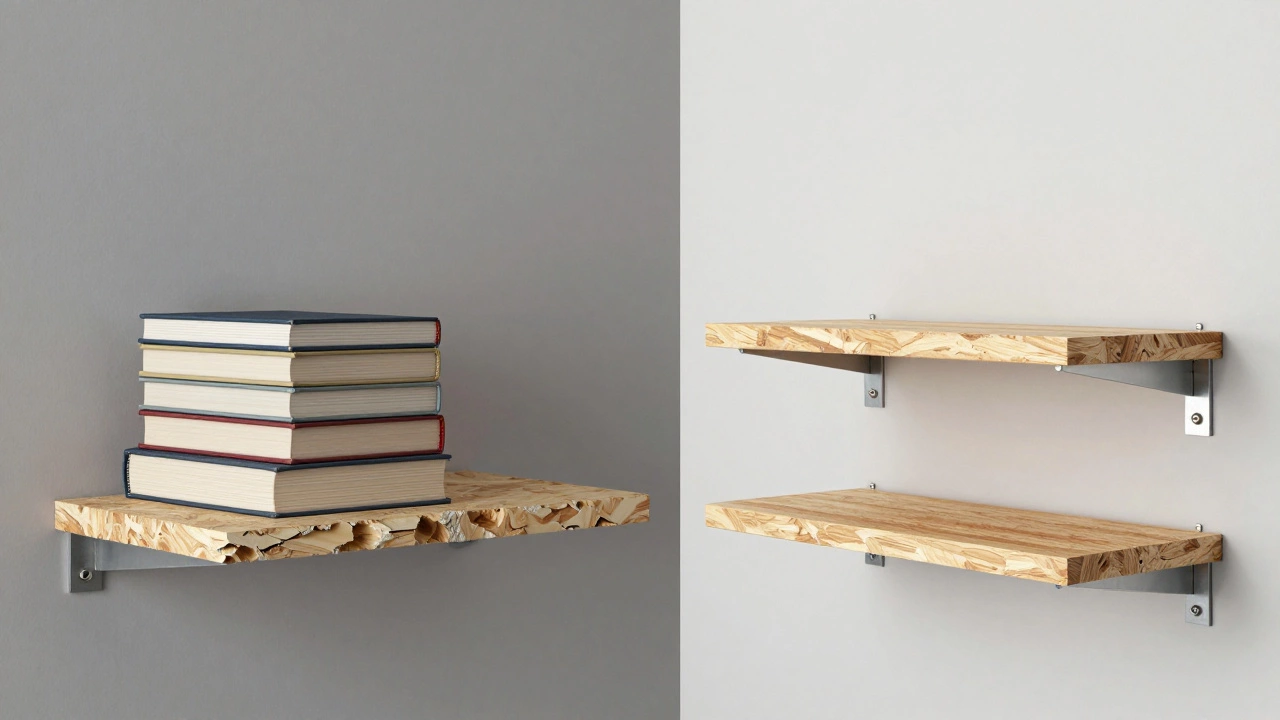
- If your shelves will be in a dry, visible area - like a living room, bedroom, or home office - and you want a clean, painted finish: Choose MDF.
- If your shelves will hold heavy items - tools, boxes, appliances - and are in a garage, basement, or workshop: Choose OSB.
- If you’re building outdoor shelves - even covered ones - skip both. Use cedar or pressure-treated timber.
- If you’re on a tight budget and need quick results: MDF is faster to install. But if you want it to last 10+ years, OSB wins.
One more tip: Always use at least 3/4-inch thickness. Anything thinner will sag, no matter the material. And never skip supports. For shelves longer than 30 inches, use supports every 16 inches. Metal brackets, wooden cleats, or L-brackets - all work. Just make sure they’re anchored into wall studs.
What About Other Materials?
You might be thinking: What about plywood? Or solid wood? Plywood is actually a great middle ground - stronger than MDF, smoother than OSB, and more stable than both. But it costs more. Solid wood is beautiful and durable, but it’s expensive and hard to find in wide panels.
For most DIYers, MDF and OSB are the practical choices. You don’t need to overthink it. Just match the material to the job.
Final Verdict
MDF is great for looks. OSB is great for strength.
For shelves you’ll see every day - in your home, painted white or gray - go with MDF. It’s smooth, paintable, and quiet.
For shelves that need to hold weight, survive moisture, or live in a rough space - go with OSB. It’s tough, affordable, and built to last.
There’s no "better" material. Only the right material for your job.