How Much Money to Spend on a Couch? The 2026 Buyer's Guide

Sofa Value Calculator
Your Requirements
Recommended Budget
Mid-RangeEstimated lifespan: 7-10 years
Total Estimated Cost:
Key Features You Should Expect:
- Hardwood frame construction
- High-resilience foam cushions
- Durable fabric with good rub count
A mid-range sofa offers the best balance of durability and cost for family use, lasting significantly longer than budget options.
You sit on it every day. It holds your weight, your kids, and occasionally the dog. Yet, when you walk into a showroom or scroll through online listings, the price tags for couches are upholstered seating furniture designed for multiple people, ranging from budget-friendly options to high-end designer pieces can feel like a total guessing game. One looks like $500, another identical-looking one is $3,000. What gives?
The short answer is that you should spend between $800 and $2,500 for a couch that will last you five to ten years without sagging, staining, or falling apart. If you’re looking at something under $500, you’re likely buying a temporary fix. If you’re paying over $4,000, you’re paying for brand prestige, exotic materials, or custom craftsmanship.
But "how much" isn't just about picking a number. It’s about understanding what you’re actually buying. A cheap frame rots. Cheap foam flattens. Cheap fabric pills. Let’s break down exactly where your money goes so you don’t waste it.
The Three Tiers of Sofa Pricing
To figure out your budget, you first need to know which tier you’re shopping in. The market generally splits into three distinct categories based on construction quality and longevity.
| Tier | Price Range (NZD) | Lifespan | Best For |
|---|---|---|---|
| Budget / Entry-Level | $300 - $700 | 1-3 Years | Students, temporary rentals, guest rooms |
| Mid-Range / Quality | $800 - $2,500 | 5-10 Years | Families, daily use, long-term homeowners |
| Premium / Luxury | $2,500+ | 10-20+ Years | Design enthusiasts, heirloom pieces, heavy daily use |
The Budget Tier is furniture made with particleboard frames, polyester blends, and low-density foam often sold by big-box retailers. These are fine if you’re in a flat share in Wellington and plan to move in two years. But they aren’t built to last. The legs wobble after six months, and the seat cushions turn into flat pancakes within a year.
The Mid-Range Tier is the sweet spot for most buyers, featuring hardwood frames, high-resilience foam, and durable fabrics. This is where you get real value. You’re paying for solid wood joinery instead of glue-and-nails, and fabric that can be cleaned without disintegrating.
The Premium Tier is high-end furniture using full-aniline leather, hand-tufted springs, and kiln-dried hardwoods. Brands here charge for aesthetics, heritage, and customization. If you love Italian design or want a sofa that matches your exact wall color down to the shade, this is your zone.
Where Does Your Money Actually Go?
When you see a $1,500 tag, you might wonder why it’s not $500. The difference isn’t marketing; it’s materials. Here is the breakdown of what drives up the cost.
1. The Frame: Wood vs. Particleboard
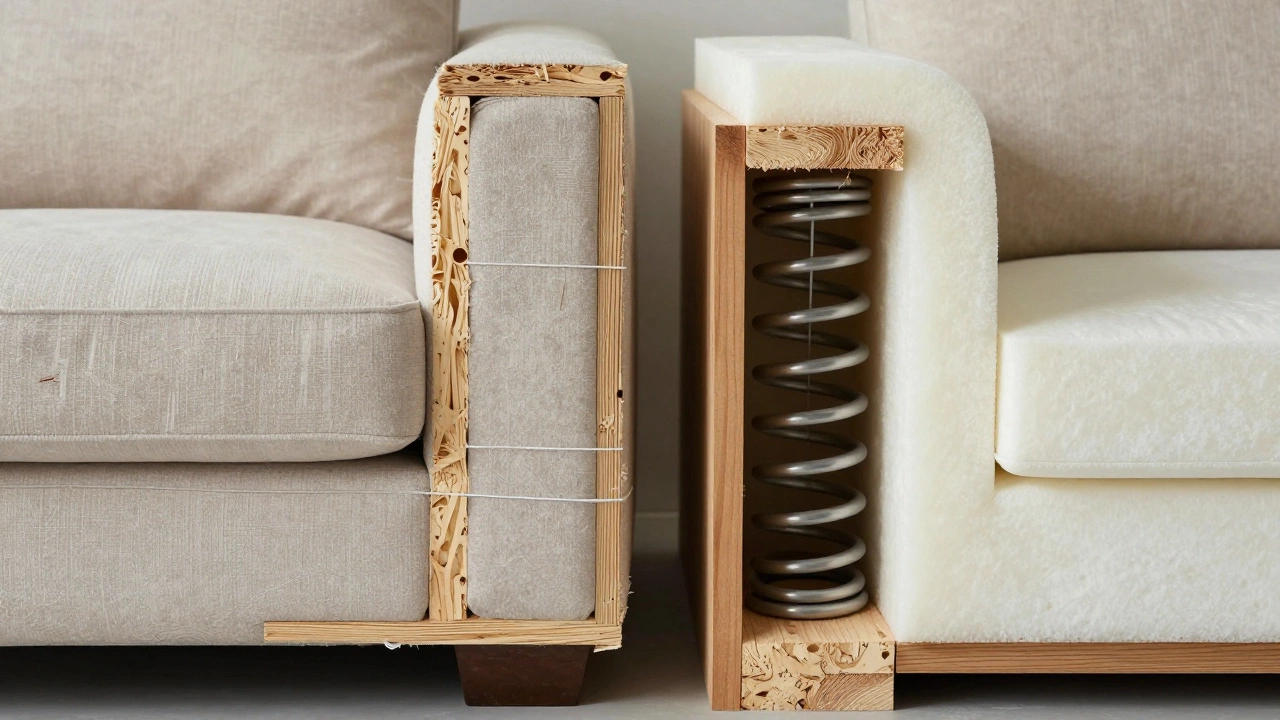
The skeleton of the sofa is everything. Cheap sofas use particleboard is engineered wood made from compressed sawdust and resin, prone to swelling and breaking or softwoods like pine. These warp in humid climates and snap under stress. Quality sofas use hardwood is dense timber such as oak, maple, or ash, known for strength and durability or kiln-dried plywood. Kiln-drying removes moisture, preventing warping. This alone adds hundreds to the cost because hardwood takes longer to source and process.
2. The Suspension: Springs vs. Webbing
Cheap sofas use elastic webbing-rubbery strips stretched across the frame. They sag quickly. Better sofas use sinuous springs are continuous S-shaped metal wires that provide flexible support, which are more resilient. The best use eight-way hand-tied springs are individual coils tied by hand to create a custom, durable support system. Hand-tying is labor-intensive, which explains the higher price tag on luxury brands.
3. The Cushioning: Foam Density Matters
This is the biggest trap. Manufacturers often hide the truth behind fluffy covers. Look for high-resilience foam is polyurethane foam with a density of 1.8 lbs per cubic foot or higher, resistant to permanent indentation. Low-density foam (under 1.5 lbs) feels soft initially but collapses. High-density foam costs more to produce but retains its shape for years. Some mid-range sofas mix foam with fiberfill for a softer look, but pure high-density foam lasts longer.
4. The Fabric: Rub Count is Key
Fabric isn’t just about looks; it’s about durability. The industry uses the Martindale test is a standard method for measuring fabric abrasion resistance, indicating how many rubs the material can withstand. For light residential use, aim for 15,000 rubs. For families with kids and pets, you want 30,000+. Performance fabrics like Crypton is a proprietary fabric technology that resists stains, moisture, and odors while maintaining breathability cost more upfront but save you money on cleaning or replacement later.
Hidden Costs You Should Budget For
The sticker price is rarely the final price. When calculating how much money to spend on a couch, add these potential extras:
- Delivery Fees: In New Zealand, delivery to major cities like Auckland or Wellington might be free for orders over $1,000, but remote areas or stairs incur extra charges ($50-$150).
- Assembly: Most modern sofas come partially assembled, but some require attaching legs or arms. If you’re not handy, factor in an hour of help.
- Protection Sprays: Applying a stain guard (like Scotchgard) costs around $30-$60 but can extend the life of fabric sofas significantly.
- Old Sofa Disposal: Council bulk waste collection fees or donation pickup services can range from $50 to $100.
Is Buying Used a Smart Move?
In 2026, second-hand markets like Trade Me and Facebook Marketplace are booming. You can find a $2,000 sofa for $600. Is it worth it?
It depends. Inspect the frame first. Lift the sofa-if it’s incredibly light, it’s probably particleboard and near the end of its life. Check the corners for cracks or separation. Sit on it hard. Does it creak? That’s the frame failing.
Fabric issues are harder to spot. Smell it. Old smoke, pet urine, or mold smells are nearly impossible to remove completely. If the previous owner had cats, avoid it entirely unless you’re willing to reupholster it, which costs $1,000+.
Buying used makes sense if you’re on a tight budget and find a solid hardwood frame with good suspension. Just accept that the comfort level may have degraded.

When to Splurge vs. Save
Not all sofas deserve the same investment. Use this quick decision tree:
- Splurge On: Your main living room sofa. This is the piece you use daily. Invest in hardwood frames, high-resilience foam, and performance fabrics. A $1,500 sofa that lasts 10 years costs $150/year. A $500 sofa replaced every 3 years costs $166/year. The math favors quality.
- Save On: Guest room sofas, sunroom chairs, or temporary rental furniture. Here, aesthetics matter more than longevity. A stylish $400 piece from a fast-furniture retailer is perfectly acceptable.
- Consider Mid-Range For: Family rooms with kids. You need durability, but you don’t need heirloom quality. Look for stain-resistant fabrics and sturdy frames in the $900-$1,200 range.
Final Thoughts on Sofa Value
How much money to spend on a couch comes down to your lifestyle. If you’re single, live in a small apartment, and change homes often, a budget sofa is fine. But if you’re settling into a family home, view the sofa as a long-term asset. Spending $1,200 today saves you the hassle, cost, and environmental waste of replacing it in three years.
Don’t let sales tactics rush you. Sit on the sofa for at least 10 minutes. Read the specs. Ask about the frame wood and foam density. If the seller can’t tell you, keep walking. Your back-and your wallet-will thank you.
What is the average price of a couch in New Zealand?
The average price for a decent quality couch in New Zealand ranges from $800 to $1,500 NZD. Budget options start around $400, while premium designer pieces can exceed $3,000.
Are expensive couches worth it?
Yes, if you plan to keep the sofa for more than five years. Expensive couches typically use hardwood frames, high-resilience foam, and durable fabrics that resist wear and tear, offering better long-term value than cheaper alternatives that need frequent replacement.
How do I know if a sofa frame is good quality?
Lift the sofa; a heavier weight usually indicates a solid wood frame rather than particleboard. Check the underside for corner blocks glued and screwed into place. Avoid frames held together only by nails or staples.
What fabric is best for families with pets?
Look for performance fabrics like Crypton or microfiber, which resist stains and odors. Leather is also a good option as it’s easy to wipe clean. Avoid loose weaves or velvet, which trap hair and are harder to clean.
Should I buy a sofa on sale?
Sales can offer great deals, especially during holiday periods like Black Friday or end-of-financial-year clearances. However, ensure the discount doesn’t apply to lower-quality models introduced specifically for the sale. Stick to trusted brands and check reviews.