How Much Does Supply Chain Software Cost? A 2026 Pricing Guide

Supply Chain Software Cost & ROI Calculator
Configuration
Hidden Costs Setup
Financial Analysis
Projected Annual Savings
Stop guessing. Start calculating.
If you are asking how much supply chain software costs, the honest answer is: it depends entirely on what you are trying to fix. But if you want a number to put in your budget spreadsheet right now, here is the reality for 2026. Small businesses using basic inventory tools pay between $50 and $300 per month. Mid-sized companies investing in integrated logistics platforms spend $1,000 to $5,000 monthly. Large enterprises deploying full-scale enterprise resource planning (ERP) with advanced analytics can expect annual contracts ranging from $50,000 to over $500,000.
The price tag isn't just about the license fee anymore. The real cost lies in implementation, integration, and training. Many companies get blindsided by hidden fees that double their initial estimate. To help you avoid that trap, we need to break down exactly where the money goes, who charges what, and how to calculate the return on investment before you sign anything.
Understanding the Pricing Models
Gone are the days when you bought software once and owned it forever. Today, almost all Supply Chain Management (SCM) software operates on a subscription model. This shift has changed how vendors charge you. You need to understand these three main structures to compare apples to apples.
SaaS Subscription (Software as a Service): This is the most common model. You pay a monthly or annual fee. It usually includes hosting, updates, and customer support. Prices are often tiered based on features. For example, a basic tier might only track stock levels, while the premium tier adds demand forecasting and supplier collaboration tools.
Per-User Licensing: Some vendors charge per seat. If you have ten people accessing the system, you pay for ten licenses. Watch out for 'admin' vs. 'viewer' pricing. Admin accounts, which allow changes to data and settings, often cost significantly more than read-only viewer accounts.
Usage-Based Pricing: Newer platforms charge based on volume. This could be the number of SKUs managed, the number of transactions processed, or even API calls made. This model is great for startups with low volume but can become expensive as you scale. If you process 100 orders a day, it’s cheap. If you jump to 10,000, your bill spikes.
Cost Breakdown by Company Size
Your budget depends heavily on your operational complexity. Here is what the market looks like in 2026 for different business sizes.
| Business Size | Typical Features Needed | Monthly Cost Range | Implementation Time |
|---|---|---|---|
| Small Business / Startup | Inventory tracking, basic purchasing | $50 - $300 | 1 - 2 weeks |
| Mid-Market | Order management, multi-warehouse, carrier integration | $1,000 - $5,000 | 1 - 3 months |
| Enterprise | Global visibility, AI forecasting, custom ERP integration | $10,000+ (Annual contracts $50k-$500k+) | 6 - 18 months |
For small businesses, off-the-shelf solutions are sufficient. You don’t need customization; you need speed. Mid-market companies face a different challenge. They need to connect their warehouse management system (WMS) with their transportation management system (TMS). This integration requires more robust software, hence the higher price point. Enterprises deal with global compliance, multiple currencies, and complex supplier networks, requiring bespoke configurations that drive up costs significantly.
Hidden Costs That Blow Up Budgets
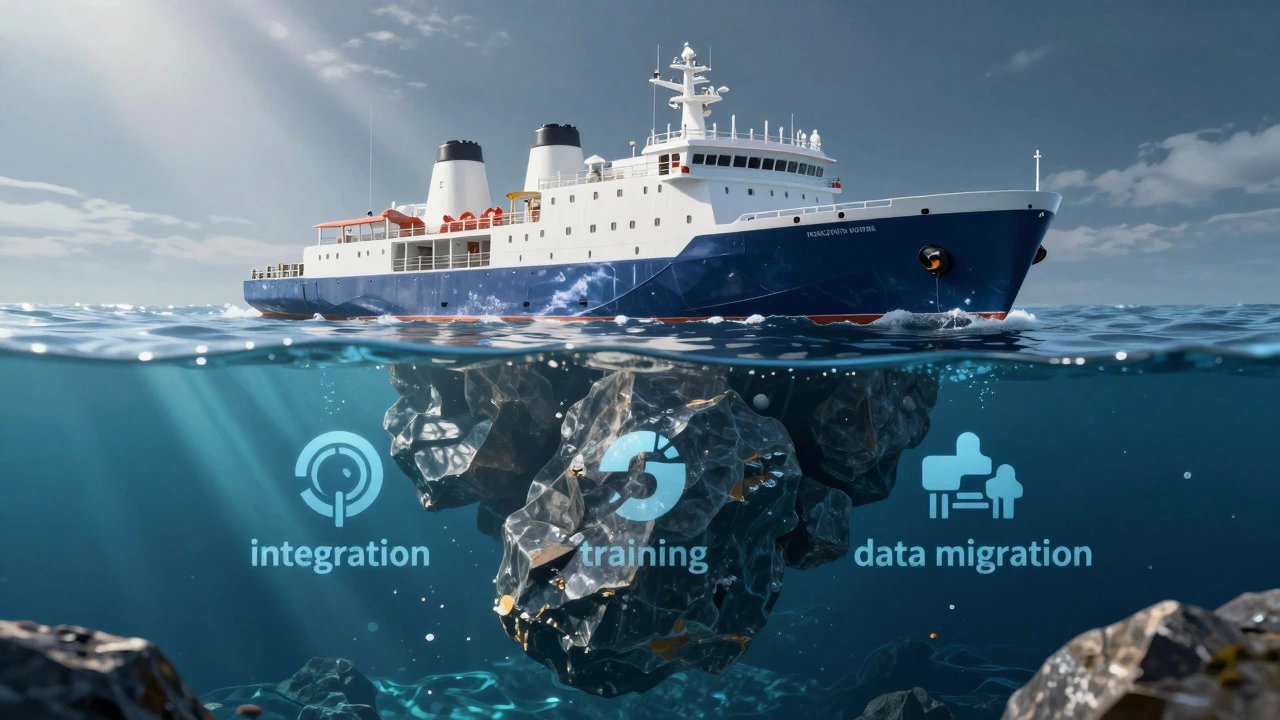
The subscription fee is just the tip of the iceberg. When negotiating with vendors, ask specifically about these additional costs. Ignoring them is the fastest way to miss your ROI targets.
- Implementation Fees: Even SaaS platforms require setup. Vendors often charge a one-time fee for configuring the system to match your workflows. For mid-market solutions, this can range from $5,000 to $20,000. Enterprise implementations can exceed $100,000 due to the complexity of data migration and custom coding.
- Data Migration: Moving historical data from spreadsheets or legacy systems into new software is messy. You may need consultants to clean and format your data. Expect to pay hourly rates for data specialists if the vendor doesn’t include this service.
- Integration Costs: Your supply chain software needs to talk to your e-commerce platform, accounting software, and shipping carriers. Each connection (API) might have a setup fee or a monthly maintenance cost. Complex integrations with older ERP systems often require middleware, adding another layer of expense.
- Training and Onboarding: Software is useless if your team doesn’t know how to use it. Basic video tutorials are usually included. However, live training sessions, especially for large teams, often come at an extra cost. Calculate the lost productivity during training hours as well.
- Support Tiers: Standard support might mean email responses within 24 hours. If you need 24/7 phone support or a dedicated account manager, expect a 20% to 50% increase in your monthly fee.
Key Factors Influencing Price
Why does one vendor charge $2,000 a month while another charges $20,000 for seemingly similar features? Several variables dictate the final price.
Modularity vs. Suite: Buying individual modules (like just a WMS or just a TMS) is cheaper upfront but creates silos. Buying an integrated suite offers better data flow but comes with a higher price tag. In 2026, modular architectures are becoming more popular, allowing you to start small and add features as needed. This approach improves cash flow but requires careful planning to ensure compatibility later.
Cloud vs. On-Premise: True on-premise solutions are rare now, but some hybrid models exist. Cloud-based software shifts infrastructure costs to the vendor, which is reflected in the subscription fee. On-premise options require significant capital expenditure (CapEx) for servers and IT staff, making them less attractive for most companies today unless strict data sovereignty laws apply.
Customization Level: Out-of-the-box software is cheapest. Every time you ask for a custom report, a unique workflow, or a specific field added to a database, the price goes up. Customizations also make future upgrades harder and more expensive. Resist the urge to customize unless it provides a clear competitive advantage.
Calculating Return on Investment (ROI)
Don't just look at the cost; look at the savings. Supply chain software should pay for itself through efficiency gains. Here is how to calculate your potential ROI.
Start with inventory carrying costs. If the software helps you reduce excess stock by 10%, multiply that reduction by your average inventory value. For a company with $1 million in inventory, a 10% reduction saves $100,000 annually. If your software costs $20,000 a year, the ROI is massive.
Next, consider labor efficiency. How many hours do your staff spend manually reconciling orders or updating spreadsheets? If automation saves two employees 10 hours a week, calculate the hourly wage savings. Add in reduced error rates. Fewer picking errors mean fewer returns and refunds, which directly impacts your bottom line.
Finally, factor in freight optimization. Advanced TMS features can negotiate better rates with carriers or optimize routes to save fuel. Even a 5% reduction in shipping costs can amount to thousands of dollars saved each month for high-volume shippers.

Navigating Vendor Negotiations in 2026
You have more leverage than you think. The market is crowded, and vendors are competing for your attention. Use these tactics to lower your total cost of ownership.
Ask for Annual Discounts: Most SaaS providers offer a discount if you pay annually instead of monthly. This typically ranges from 10% to 20%. It ties up cash upfront but reduces the overall cost.
Benchmark Competitors: Know what other vendors are charging. If Vendor A quotes $3,000 a month, tell Vendor B. Competition drives prices down. Don’t be afraid to share quotes (with sensitive details removed) to spark a bidding war.
Define Success Metrics: Tie part of the payment to performance. While rare for standard SaaS, some larger deals allow for success-based pricing. If the software doesn’t achieve agreed-upon efficiency targets, you get a credit or extension.
Review Contract Terms: Look for auto-renewal clauses and price hike limitations. Ensure there is a cap on annual price increases, usually tied to inflation indices like CPI. Also, check the exit strategy. What happens to your data if you leave? Ensure you can export it easily without paying exorbitant retrieval fees.
Choosing the Right Tool for Your Needs
Not every business needs an enterprise-grade solution. Over-engineering your tech stack is a waste of money. Assess your current pain points first.
If you struggle with stockouts and overstocking, prioritize inventory management software with strong forecasting capabilities. If your customers complain about late deliveries, invest in transportation management software that optimizes routing and carrier selection. If you have multiple warehouses and lose track of stock locations, a warehouse management system is essential.
Start with a pilot program. Most reputable vendors offer free trials or proof-of-concept periods. Use this time to test not just the features, but the usability. If your team finds the interface confusing, adoption will be low, and you won’t realize any ROI. Ease of use is a critical, often overlooked, cost factor.
What is the average cost of supply chain management software for a small business?
For small businesses, the average cost ranges from $50 to $300 per month. These solutions typically focus on basic inventory tracking and purchase order management. Implementation is usually quick, taking less than two weeks, with minimal hidden costs.
Are there hidden costs associated with SCM software?
Yes, common hidden costs include implementation fees ($5,000-$20,000 for mid-market), data migration services, third-party integration fees, and premium support tiers. Always ask for a detailed breakdown of one-time setup costs versus recurring monthly fees.
How long does it take to implement supply chain software?
Implementation time varies by complexity. Simple SaaS tools can be live in 1-2 weeks. Mid-market solutions with integrations take 1-3 months. Large enterprise deployments involving custom configurations and global data migration can take 6 to 18 months.
Is cloud-based supply chain software more expensive than on-premise?
Cloud-based software has a lower upfront cost but higher ongoing subscription fees. On-premise solutions require significant capital expenditure for hardware and IT maintenance. For most companies in 2026, cloud-based SaaS offers a better total cost of ownership due to scalability and reduced IT overhead.
How can I calculate the ROI of supply chain software?
Calculate ROI by estimating savings from reduced inventory holding costs, labor efficiency gains, and freight optimization. Subtract the total cost of ownership (subscription + implementation + maintenance) from these annual savings. A positive ROI within the first 12-18 months is a healthy benchmark.