How Much Does It Cost to Have a Pallet Delivered?
Pallet Delivery Cost Calculator
Estimate your pallet delivery costs based on weight, distance, and service options. This tool calculates standard LTL (less-than-truckload) shipping rates for single pallets.
Estimated Cost
$0.00
Liftgate: $0.00
Residential: $0.00
Fuel Surcharge: $0.00
Important: This is an estimate only. Actual costs may vary based on carrier, specific route, and other factors. Always confirm the all-in price with the carrier.
Getting a pallet delivered isn’t like ordering a book online. You’re not just paying for a box to show up at your door-you’re paying for heavy lifting, specialized equipment, and logistics that move tons of weight across cities, states, or even countries. So how much does it actually cost? The answer isn’t simple. It depends on where you’re sending it, how heavy it is, how fast you need it, and who’s hauling it. But if you know what factors matter, you can avoid surprise fees and get a fair price.
What Affects Pallet Delivery Costs?
The price of a pallet delivery breaks down into five main pieces: weight, dimensions, distance, speed, and handling. Each one changes the final bill.
Weight is the biggest driver. Most carriers charge by weight class-usually in 100-pound increments. A 500-pound pallet costs less than a 1,200-pound one. But weight isn’t just about what’s on the pallet. If your load is light but takes up a lot of space, carriers use dimensional weight to calculate cost. That means even a 200-pound pallet that’s 8 feet tall and 4 feet wide could be priced like a 1,000-pound shipment. Always measure your pallet accurately.
Dimensions matter because pallets have to fit on trucks and in warehouses. Standard pallet sizes are 48x40 inches (GMA pallet) or 48x48 inches. Anything bigger or smaller might need special handling. If your pallet sticks out past the edges or is stacked unevenly, you’ll pay extra. Carriers hate unstable loads-they’re dangerous and slow to load.
Distance is straightforward: the farther you go, the more it costs. A local delivery under 100 miles might cost $75-$150. Cross-country? That jumps to $400-$1,200. But distance isn’t just miles-it’s zones. Carriers divide the U.S. into zones (like FedEx or UPS does). A shipment from New York to Chicago is Zone 3. From New York to Los Angeles? Zone 8. Each zone adds $50-$150 to the base rate.
Speed changes everything. Standard ground delivery takes 2-7 business days and is cheapest. If you need it in 24 hours, you’re paying 2-4 times more. Overnight pallet delivery isn’t common-it’s expensive because it requires dedicated trucks and priority loading. Most carriers don’t even offer it unless you’re shipping multiple pallets.
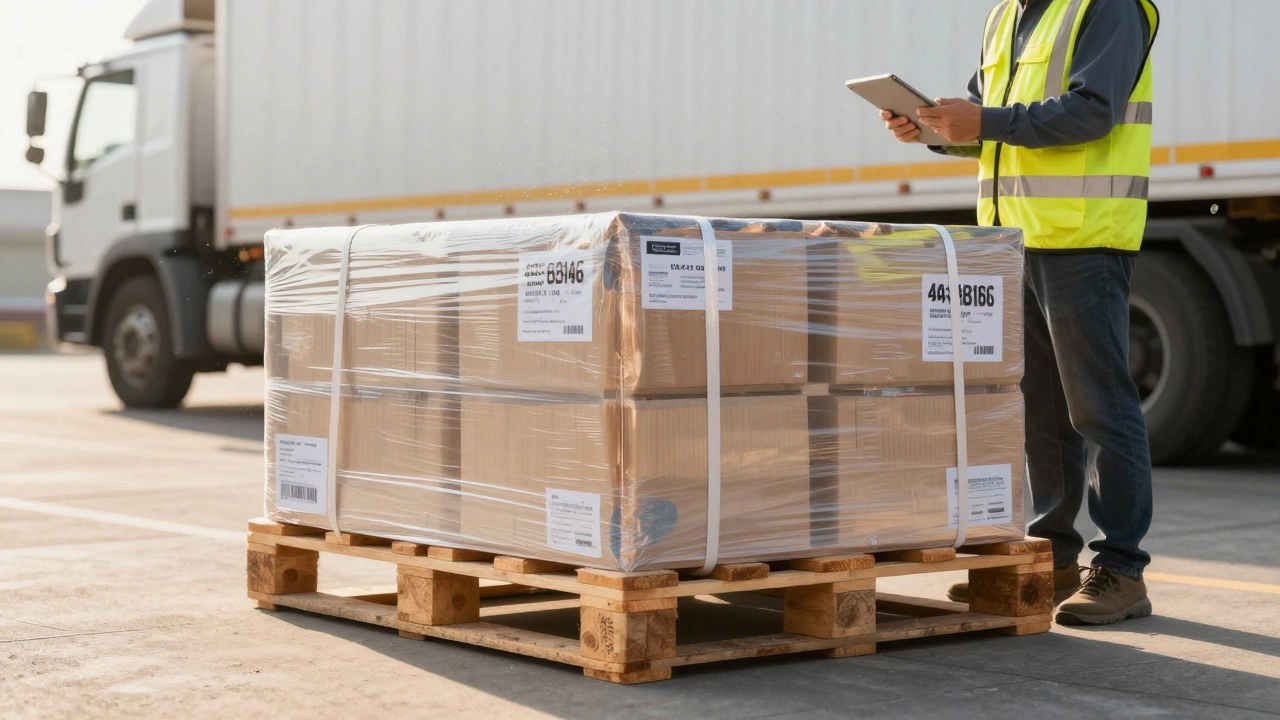
Handling is where people get shocked. If your pallet isn’t wrapped in stretch film, secured with straps, or labeled clearly, carriers charge extra. Some charge $25-$50 just to inspect or rewrap it. If you need liftgate service (a hydraulic arm that lowers the pallet to the ground), that’s another $50-$100. Same for residential delivery-most carriers add $40-$75 to deliver to a house instead of a business with a loading dock.
Typical Pallet Delivery Price Ranges
Here’s what you can expect to pay in 2025 based on real-world shipments:
- Local delivery (under 100 miles): $75-$150 for a standard 48x40x48 inch pallet under 500 lbs. No liftgate, business address.
- Regional (100-500 miles): $150-$350. Add $50 if you need liftgate or residential delivery.
- National (500-1,500 miles): $350-$800. This is the most common range for ecommerce businesses shipping from warehouses to customers.
- Long-haul (1,500+ miles): $700-$1,200. Rates drop slightly per mile at this distance because carriers fill backhauls.
- Expedited (24-48 hours): Add 100-300% to standard rates. Rarely under $500 for a single pallet.
These prices are for LTL (less-than-truckload) shipping-the most common way pallets move. If you’re shipping 10+ pallets, you might qualify for full truckload (FTL), which can cut cost per pallet by 30-50%.
Who Delivers Pallets? Carrier Options Compared
You’ve got three main choices: freight carriers, courier services, and marketplace platforms.
| Service Type | Best For | Cost Range (Single Pallet) | Delivery Time | Residential Delivery? |
|---|---|---|---|---|
| Freight Carriers Companies like FedEx Freight, YRC, Old Dominion, and Saia |
Heavy, bulky, or high-value pallets | $100-$1,200 | 2-7 business days | Yes, with fee |
| Courier Services UPS Freight, DHL Freight, Amazon Logistics |
Small to medium pallets, ecommerce returns | $80-$900 | 1-5 business days | Yes, often included |
| Marketplace Platforms uShip, ShipBob, Freightos |
Price shopping, small businesses, irregular shipping | $60-$1,100 | 2-6 business days | Yes, with fee |
Freight carriers are the most reliable for heavy or fragile items. Courier services are better if you’re shipping smaller pallets (under 700 lbs) and want online tracking. Marketplace platforms let you compare quotes from multiple carriers at once-great if you’re not shipping every week.

Hidden Fees You Can’t Ignore
Most people get blindsided by extra charges. Here are the most common ones:
- Liftgate fee: $50-$100. Required if you don’t have a loading dock.
- Residential delivery fee: $40-$75. Applies to homes, apartments, and remote locations.
- Delivery appointment fee: $50-$125. If you want the driver to show up at a specific time.
- Storage fee: $25-$75 per day. If the driver can’t deliver and the pallet sits at a terminal.
- Fuel surcharge: 10-25% of base rate. Changes weekly based on diesel prices.
- Rehandling fee: $75-$150. If your pallet is damaged, unlabeled, or improperly packed.
Always ask for a total all-in price before booking. Don’t just look at the base rate. One carrier might quote $200, but with liftgate, residential, and fuel charges, it ends up at $320. Another might quote $290 all-in. The cheaper-looking option isn’t always cheaper.
How to Save Money on Pallet Delivery
You don’t have to pay full price. Here’s how to cut costs:
- Use standard pallets. Stick to 48x40 inches. Non-standard sizes cost more to handle.
- Wrap and strap your pallet. If it looks like it might fall apart, carriers charge extra. Use stretch film and straps-it’s cheap insurance.
- Ship during off-peak times. Avoid holidays and the end of the month. Carriers are busier then and raise rates.
- Consolidate shipments. If you’re shipping 3-5 pallets to the same place, combine them. You’ll pay less per pallet.
- Use a freight broker. Brokers like Freightos or ShipBob negotiate rates with carriers. They often get 10-20% lower prices than you’d get directly.
- Choose slower delivery. If you can wait 5 days instead of 2, you’ll save 25-40%.
One ecommerce store in Ohio saved $1,800 a month just by switching from UPS Freight to a broker and consolidating three weekly shipments into two. They also started using stretch film instead of cardboard dividers-cutting damage claims and rehandling fees.
What Happens If Your Pallet Gets Damaged?
Damage happens. A pallet can shift on the truck, get dropped, or crushed by another load. Most carriers offer basic liability coverage-usually $0.50 to $1.00 per pound. That means a 1,000-pound pallet is only covered for $500-$1,000. If your goods are worth $5,000, you’re out of luck.
Always buy additional insurance if your pallet contains high-value items. It costs 1-3% of the shipment’s value. For a $3,000 pallet, that’s $30-$90. It’s worth it. Without it, you’ll spend weeks fighting for a partial payout, if you get one at all.
When Should You Use a Freight Broker?
If you ship more than 5 pallets a month, a freight broker is worth it. They don’t own trucks-they connect you with carriers who have space. Brokers have volume discounts and know which lanes are cheapest right now. They also handle tracking, claims, and documentation.
Some brokers even offer automated booking through apps. You upload your pallet details, pick a delivery window, and get a confirmed quote in 10 minutes. No phone calls, no back-and-forth emails.
For small businesses shipping once a month? Skip the broker. Just book directly with a courier like UPS Freight. The savings aren’t worth the setup time.
Final Checklist Before Booking
Before you hit confirm on your pallet delivery, run through this:
- Measure your pallet: length, width, height, and weight.
- Confirm it’s wrapped and strapped-no loose items.
- Label it clearly with pickup and delivery addresses.
- Ask for the total all-in price, including fuel, liftgate, and residential fees.
- Check if insurance is included-or buy it.
- Get a tracking number and delivery confirmation email.
Getting a pallet delivered doesn’t have to be a mystery. Know your numbers, ask the right questions, and you’ll pay less, stress less, and get your goods where they need to go-on time and intact.
How much does it cost to ship a pallet across the country?
Shipping a standard pallet (under 1,000 lbs) across the U.S. typically costs between $700 and $1,200. The exact price depends on distance, speed, and whether you need liftgate or residential delivery. For example, a 48x40 inch pallet going from Atlanta to Seattle will cost around $950 with standard ground delivery. Add liftgate and residential fees, and it could hit $1,100.
Can I ship a pallet with FedEx or UPS?
Yes, both FedEx Freight and UPS Freight handle pallet shipments. They’re ideal for pallets under 1,500 lbs and offer online tracking, residential delivery, and easy booking. But they’re not always the cheapest. For heavier or bulkier loads, traditional freight carriers like Old Dominion or YRC often have better rates.
Do I need a forklift to receive a pallet delivery?
No, you don’t need a forklift. Most deliveries are dropped at the curb or driveway. If you don’t have a loading dock, you can request a liftgate service-this is a hydraulic arm on the truck that lowers the pallet to the ground. It costs extra, usually $50-$100, but it eliminates the need for a forklift.
What’s the cheapest way to ship a pallet?
The cheapest way is to ship a standard 48x40 inch pallet, under 500 lbs, via LTL freight during off-peak times. Use a freight broker to compare rates, avoid residential delivery if possible, and choose 3-5 day delivery. For a 300-lb pallet going 500 miles, expect to pay as low as $120 all-in.
Is it cheaper to ship multiple pallets at once?
Yes, shipping multiple pallets together almost always lowers the cost per pallet. Carriers fill their trucks more efficiently and reduce handling time. If you’re shipping 3-5 pallets to the same address, you can save 20-40% compared to shipping them separately. Some carriers even offer volume discounts for 10+ pallets.
Why is pallet delivery so expensive?
Pallet delivery is expensive because it requires specialized equipment, trained drivers, and complex logistics. A single pallet can weigh over a ton. Moving it safely across the country needs heavy-duty trucks, secure loading, and terminals with forklifts. Fuel, labor, insurance, and maintenance all add up. Unlike small packages, pallets can’t be sorted by machines-they require manual handling, which increases labor costs.
Next Steps
If you’re shipping a pallet next week, start by measuring it and weighing it. Then, get quotes from at least two carriers and one broker. Don’t just pick the lowest number-check what’s included. A $100 difference in price could mean $200 in hidden fees. And if you’re shipping high-value items, never skip insurance. One damaged pallet can cost more than ten deliveries.
For small businesses, the best move is to build a relationship with one reliable carrier. Over time, you’ll get better rates, faster service, and fewer surprises. Keep a log of your shipments-what you paid, what went wrong, what worked. That data becomes your bargaining chip when you negotiate rates.